Chapter 5: Solving Cubic Equations Using Trigonometry
After Ars Magna was published, Cardano’s method to solve cubic equations became more widely known.1 However, the casus irreducibilis prevented a purely real use of the method from solving all cubic equations. The cubic formula is unable (without complex numbers) to solve cubic equations with three distinct real solutions, because the quantity under its square root is negative.
François Viète discovered a solution involving trigonometric substitution to solve cubics with three real solutions. His method appeared in Supplementum Geometriae (1593), later included in the posthumous collection Opera Mathematica (1646). His In Artem Analyticem Isagoge (1591) introduced a systematic use of letters for known and unknown quantities, an important step toward modern algebraic notation.2 I will present the algebra behind the method first, and then a truly magical geometric interpretation of Viète’s method.
The Shape of a Cubic
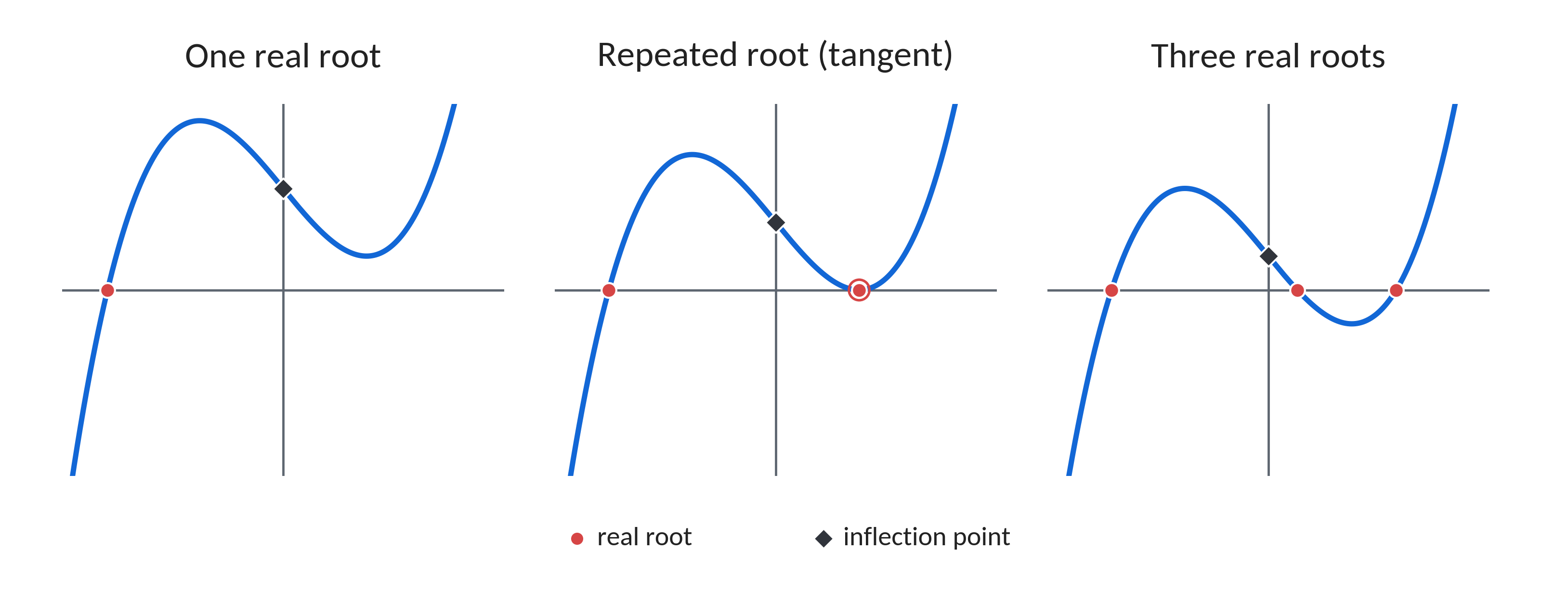
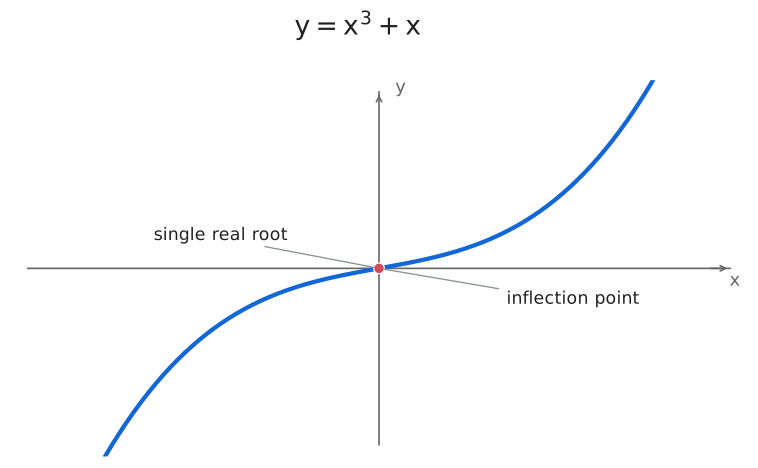
Before we try Viète’s trigonometric method, let’s look at the problem on a graph. The real roots of a cubic are the points where its graph crosses the x-axis, or sometimes just touches it. A real cubic can have one distinct real root, a repeated root along with another real root, or three distinct real roots. Those cases look quite different, even though they all come from equations of the same degree.
The three-real-root case is especially strange. The graph shows three real answers, but Cardano’s formula from Chapter 2 leads to a negative number under a square root. The graph is not asking us to find imaginary answers: it is asking why a formula for real answers has to take such a surprising detour. This is the puzzle that Viète’s trigonometric method will address. Later, the turning points and inflection point will also help us understand a triangle hidden in the same cubic.
The Algebraic Method
Setup and Substitution
As with other methods, this method assumes you already have a depressed cubic to begin with,
\[x^{3} + px + q = 0\]
We now consider the cosine triple-angle formula we have derived earlier:
\[\cos(3\theta) = 4\cos^{3}(\theta) - 3\cos(\theta)\]
Moving everything to the right side, we get
\[4\cos^{3}(\theta) - 3\cos(\theta) = \cos(3\theta)\]
Dividing by 4, we get the formula
\[\cos^{3}(\theta) - \frac{3}{4}\cos(\theta) - \frac{1}{4}\cos(3\theta) = 0\]
Now, we have an equation that looks like a depressed cubic in terms of \(\cos(\theta)\), with a cubic term, linear term, and a constant in terms of \(\cos(3\theta)\), different from our original expression.
The idea now is to make a substitution so our depressed cubic looks like the above identity, and by matching terms we can isolate \(x\).
We can now set \(x = y\ \cos(\theta)\), where \(y\) and \(\theta\) are our unknowns. \(\theta\) is the variable we have seen before, and \(y\) is a positive scaling factor.
\[y^{3}\cos^{3}(\theta) + py\cos(\theta) + q = 0\]
Dividing through by \(y^{3}\) gives
\[\cos^{3}(\theta) + \frac{p}{y^{2}}\cos(\theta) + \frac{q}{y^{3}} = 0\]
Finding y by Matching Coefficients
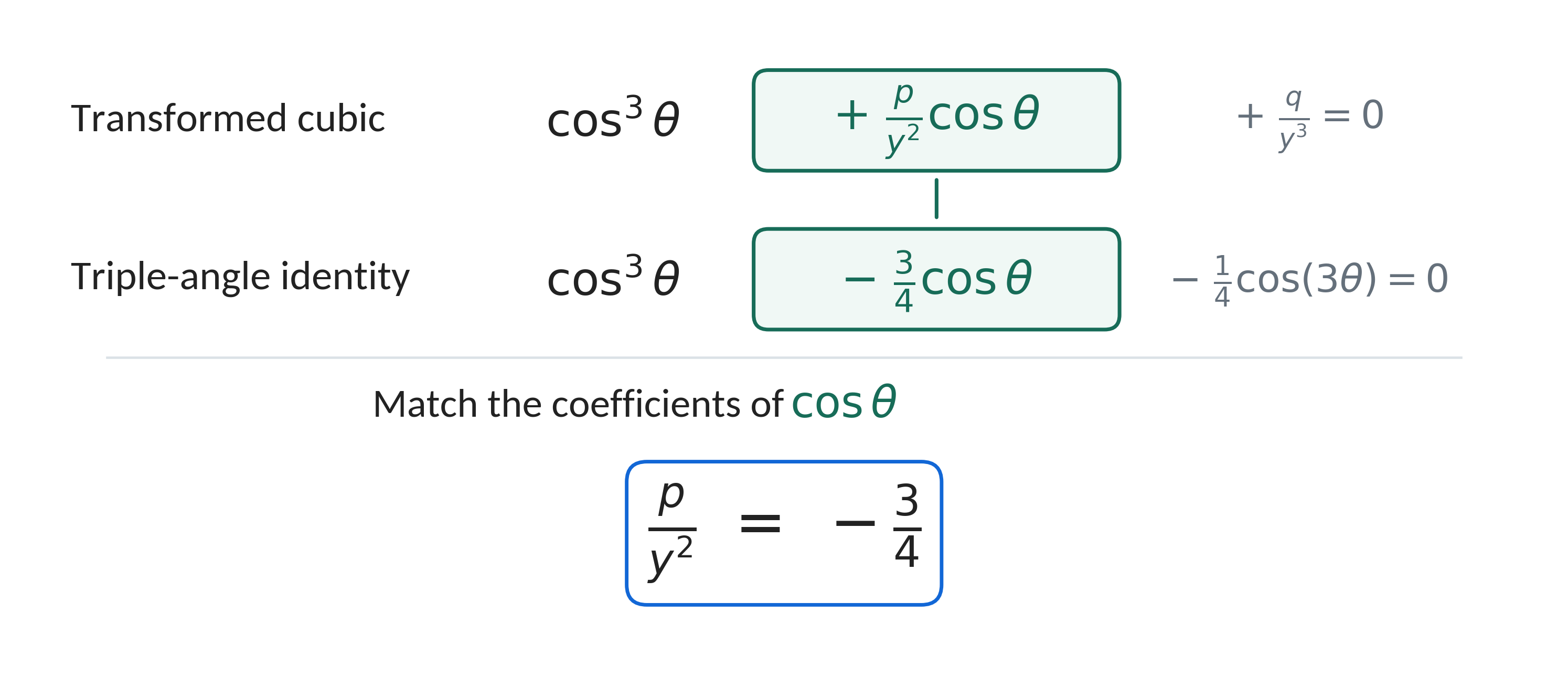
Since we want our equation to look like the triple-angle identity, we set \(\frac{p}{y^{2}} = - \frac{3}{4}\) by matching coefficients. From this equation we can figure out\(\ y\).
Multiplying both sides by \(y^{2}\), we get
\[p = - \frac{3}{4}y^{2}\]
Cancelling the fractions on the right side,
\[- \frac{4}{3}p = y^{2}\]
Finally, taking the square root yields
\[2\sqrt{- \frac{p}{3}} = y\]
We now must assume that\(\ p\ \)is negative in order to get a positive number under the square root sign, but this is ok because we are starting with three distinct real solutions, and in this case \(p < 0\).
Finding θ by Matching Coefficients
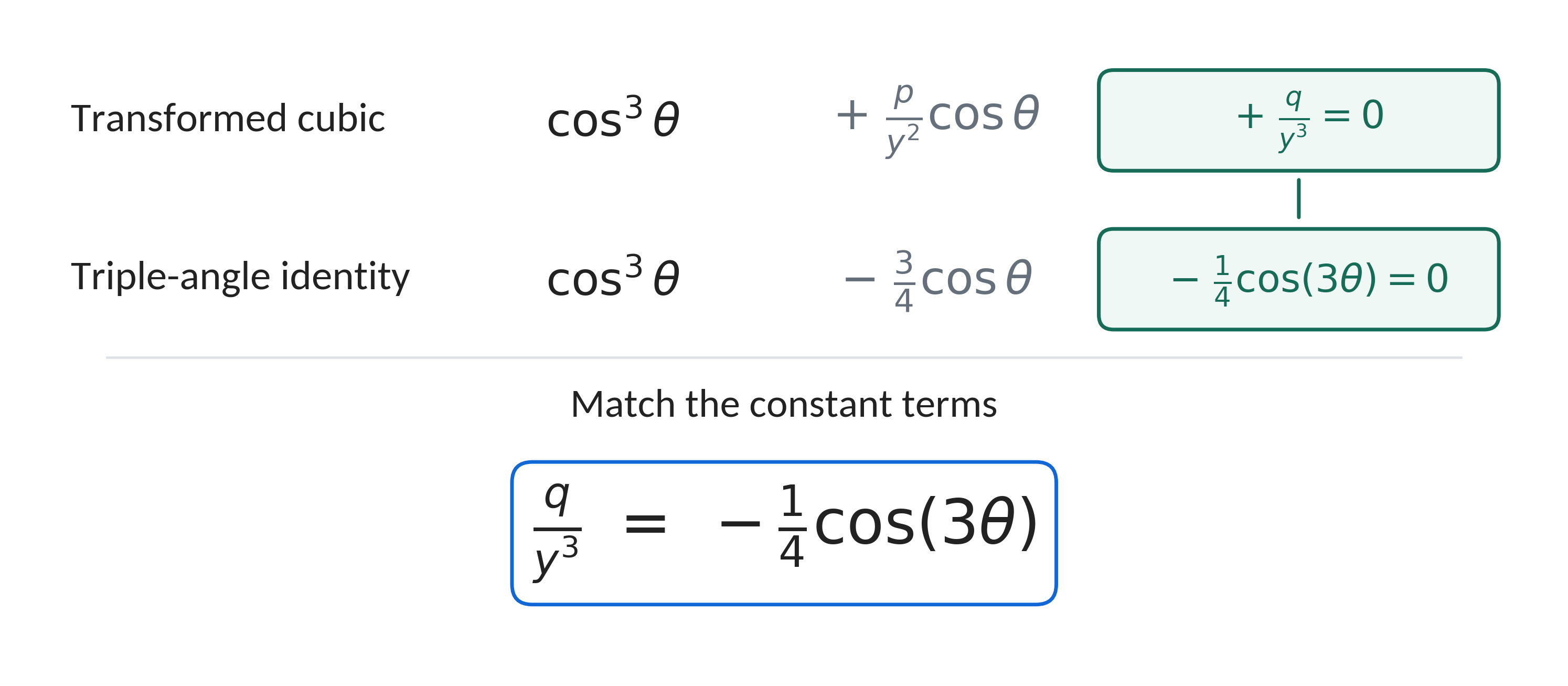
Now that we have \(y\), we can match up the \(\cos(3\theta)\) term to find \(\theta\). Because we want the identities to match up perfectly, we set
\[\frac{q}{y^{3}} = - \frac{1}{4}\cos(3\theta)\]
Substituting for \(y\), we find
\[\frac{q}{\left( 2\sqrt{- \frac{p}{3}} \right)^{3}} = - \frac{1}{4}\cos(3\theta)\]
We must now solve this equation for \(\theta\). Expanding out the cube in the denominator, we obtain
\[\frac{q}{\frac{- 8p}{3}\sqrt{- \frac{p}{3}}} = - \frac{1}{4}\cos(3\theta)\]
We can multiply both sides by -4 to get:
\[\frac{q}{\frac{2p}{3}\sqrt{- \frac{p}{3}}} = \cos(3\theta)\]
Taking the terms outside of the denominator, we get:
\[\frac{3q}{2p}\sqrt{- \frac{3}{p}} = \cos(3\theta)\]
Now we take the principal inverse cosine to choose one value of \(\theta\). But this requires the expression on the left to be between -1 and 1, inclusive. Luckily, when \(p\) is negative and a cubic has three real roots, counted with multiplicity, this expression is in that interval, so we are allowed to take the inverse cosine. For this choice, 3θ is between 0 and half a turn, and we get
\[\arccos\left( \frac{3q}{2p}\sqrt{- \frac{3}{p}} \right) = 3\theta\]
Dividing by 3, we finally get
\[\theta = \frac{1}{3}\arccos\left( \frac{3q}{2p}\sqrt{- \frac{3}{p}} \right)\]
Solving the Cubic
Because we have both \(y\) and \(\theta\) in terms of \(p\) and \(q\), we can substitute in both expressions to find \(x\). Recall that \(x = y\cos(\theta)\). Substituting in, our final formula is:
\[x = 2\sqrt{- \frac{p}{3}}\cos\left( \frac{1}{3}\arccos\left( \frac{3q}{2p}\sqrt{- \frac{3}{p}} \right) \right)\]
Now we have one real solution to our cubic.
What about the others? They come from examining the function \(\cos(3\theta)\) more closely. Its graph gets “compressed” by a factor of 3, and therefore it completes three full cycles in a full circle rotation.
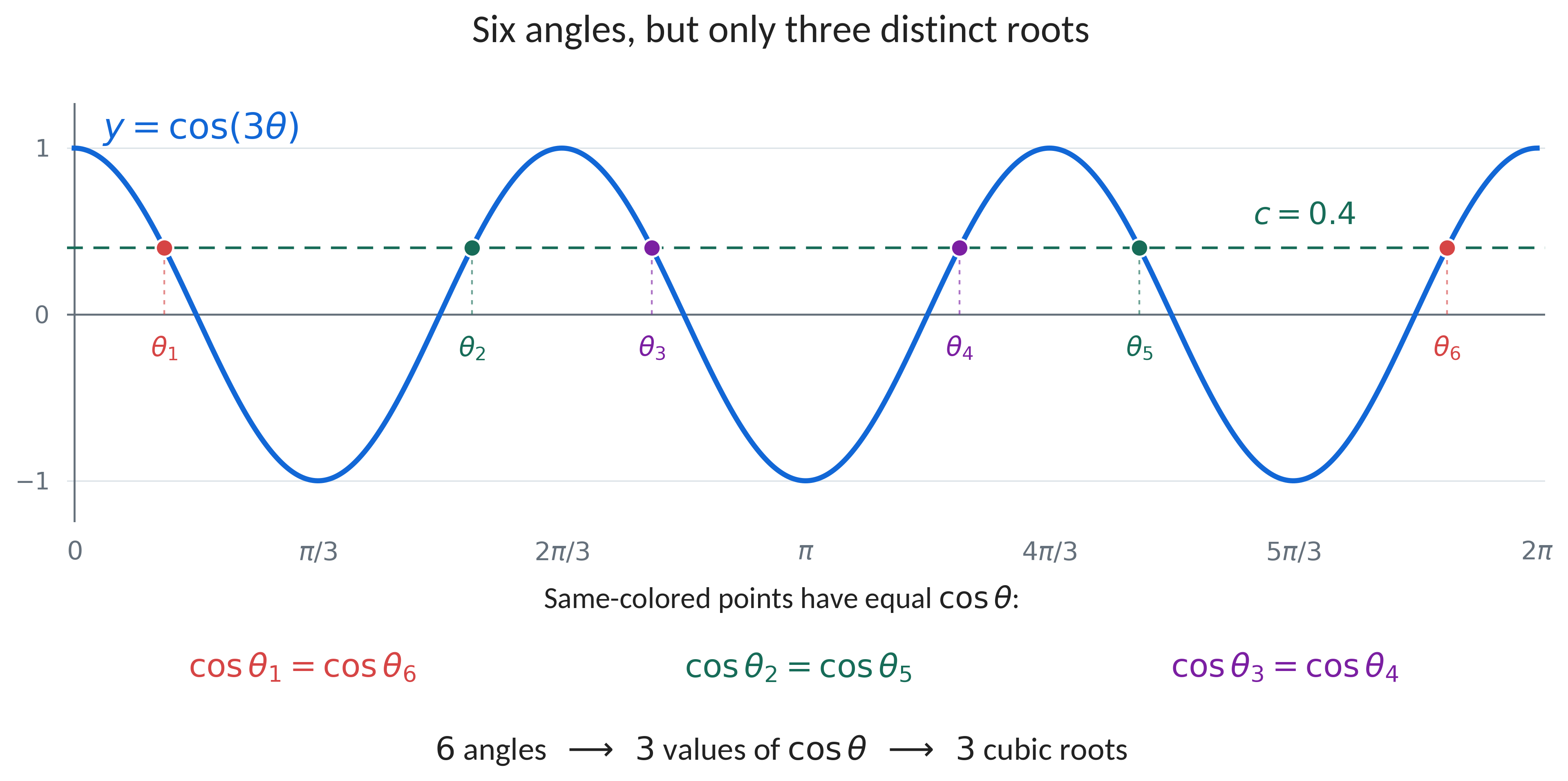
So, while the identity of \(\cos(3\theta) = 4\cos^{3}(\theta) - 3\cos(\theta)\) is true, when the roots are distinct there are two other values that \(\cos(\theta)\) can take on, by adding on \(\frac{1}{3}\) and \(\frac{2}{3}\) of a full rotation.
The triple-angle value stays the same. These correspond to angles of \(\frac{\tau}{3}\) and \(\frac{2\tau}{3}\); therefore the more general formula is:
\[\boxed{x = 2\sqrt{- \frac{p}{3}}\cos\left( \frac{1}{3}\arccos\left( \frac{3q}{2p}\sqrt{- \frac{3}{p}} \right) + \frac{\tau k}{3} \right)}\]
where \(k = 0,1,2\)
Choosing the \(k\) value yields our three solutions to our depressed cubic.
The Sine-Form Alternative
There is another similar-looking identity we could’ve used instead:
\[\sin(3\theta) = 3\sin(\theta) - 4\sin^{3}(\theta)\]
If we had rearranged and substituted in for sine, we would have arrived at a very similar-looking formula, with the sine replacing the cosine and a negative sign inside the arcsine function.
\[x = 2\sqrt{- \frac{p}{3}}\sin\left( \frac{1}{3}\arcsin\left( - \frac{3q}{2p}\sqrt{- \frac{3}{p}} \right) + \frac{\tau k}{3} \right),\]
where \(k = 0,\ 1,\ 2\)
Both formulas provide correct answers when the depressed cubic has three real roots, counted with multiplicity, and\(\ p\ \)is negative.
The endpoint values -1 and 1 are allowed, so a double root appears twice among the three answers. The formulas do not give real-angle solutions when there is one real root and two nonreal roots.
When \(p\) is zero, we can instead take the real cube root of -q directly; if \(q\) is also zero, the root 0 is triple.
The Geometric Method
Geometric Background and Setup
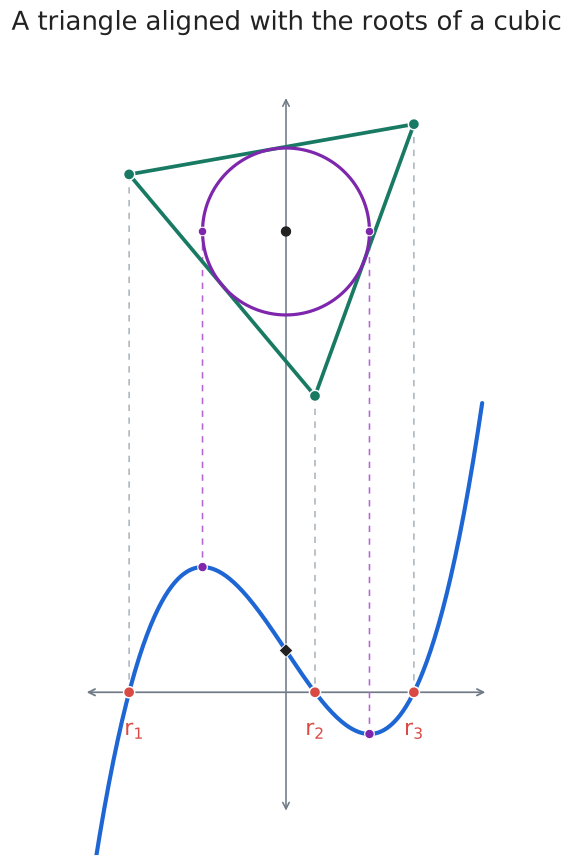
Due to a truly magical real-root version of Marden’s theorem, we can find the roots of a cubic with three real roots, not all equal, using a triangle.
To understand the geometry behind this method, let's look more closely at the graph's turning points and inflection point. In all cubic graphs, there is a point called the inflection point in the “middle” of the curve where the curve changes the way it bends. Turning points are where the curve changes from rising to falling or vice versa. Some cubics have two turning points, while others have none. The monotone example below shows why we cannot assume every cubic has a local maximum and minimum.
If the cubic has two turning points, the highest and lowest points on the bumps are called the local maximum and minimum, or extrema. If you take the average of the x-coordinates of the extrema, this is the x-coordinate of the inflection point.
In depressed cubics the inflection point is always on the y-axis.
If we position an equilateral triangle above the graph, with its center above the inflection point, it is always possible to rotate and scale this triangle such that all three vertices line up with the roots below. If two roots coincide, two vertices share the same x-coordinate.
What’s more is that, if we draw the inscribed circle of the triangle, the leftmost and rightmost points are in line with the graph’s extrema.3
Scaling the Triangle
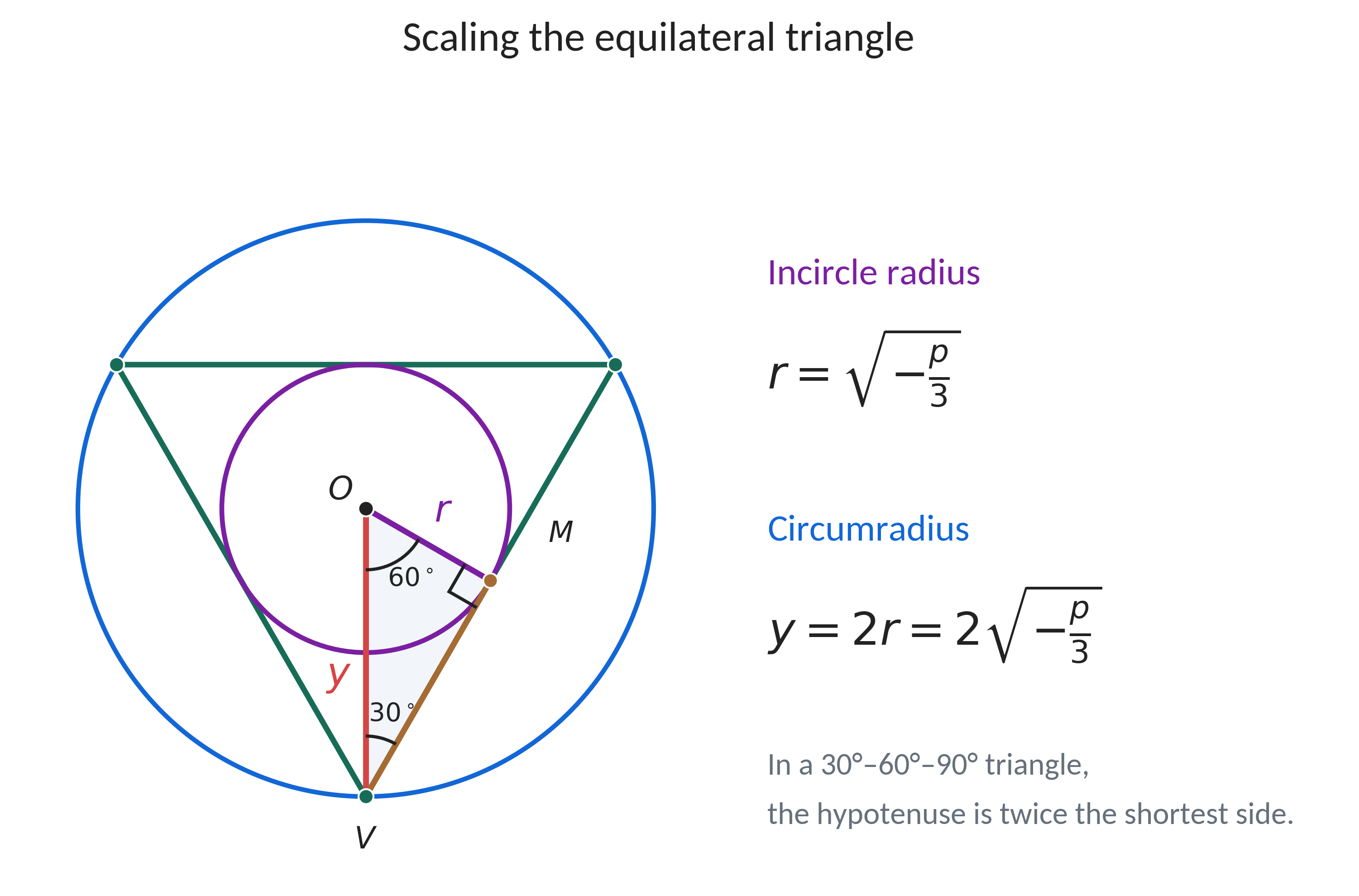
Using this information, we can figure out the x-coordinates of the vertices, and thus find the roots of the cubic. The extrema of a depressed cubic equation have x-coordinates of \(\pm \sqrt{- \frac{p}{3}}\), and we can use this to figure out how large the equilateral triangle is.
Because the extrema line up with the leftmost and rightmost points of the inscribed circle, the radius of the inner circle must be \(\sqrt{- \frac{p}{3}}\).
Now, we can circumscribe an outer circle around the triangle, to figure out the angle of rotation. To find the radius of the outer circle, we can form a 30-60-90° right triangle inside of the equilateral triangle. We already know the length of the shortest side, \(\sqrt{- \frac{p}{3}}\). Therefore, the length of the longest side, the distance between the center and the vertices, is \(2\sqrt{- \frac{p}{3}}\). This is also the radius of the outer circle. Therefore, what \(y\) in the algebraic derivation represents is how much the triangle has been scaled up, and the distance between the center and the vertices.
\[\boxed{r_{out}\ = \ y\ = \ 2\sqrt{- \frac{p}{3}}}\]
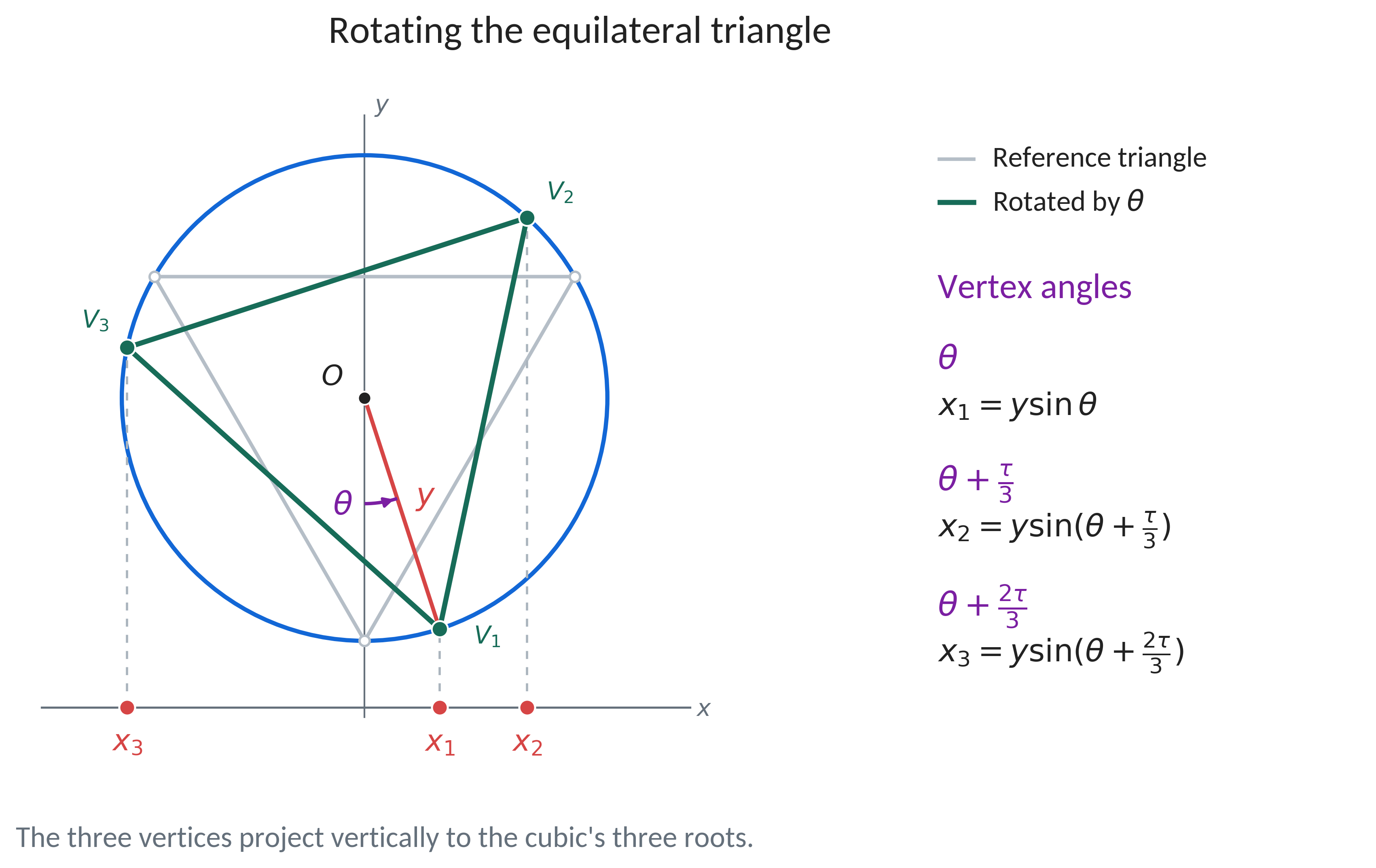
Using the outer circle, we can get the precise roots in terms of our rotation angle, \(\theta\). Set a starting triangle such that the bottom vertex is set on the y-axis. Our rotated triangle will have the vertices rotated counterclockwise by the angle \(\theta\) from this starting triangle. Here \(\theta\) is measured from the downward radius and is the angle used in the sine formula. This is our geometric interpretation of \(\theta\).
Rotating the Triangle
Now, for the bottom vertex, we can visualize the new x-coordinate by using the outer circle. The signed horizontal displacement of the point is precisely \(r_{out}\ \sin(\theta)\). We already know the radius, so our first root is
\[x_{1} = 2\sqrt{- \frac{p}{3}}sin(\theta)\]
By the same logic, the second root’s angle on the circle is \(\theta + 120{^\circ}\), or \(\theta + \frac{\tau}{3}\) radians. So, the second root is
\[x_{2} = 2\sqrt{- \frac{p}{3}}\sin\left( \theta + \frac{\tau}{3} \right)\]
The third root therefore is expressed as
\[x_{3} = 2\sqrt{- \frac{p}{3}}\sin\left( \theta + \frac{2\tau}{3} \right)\]
Now, our goal is to isolate \(\theta\), to find the roots from the above expressions. We can do this using the factorization of our cubic. Since \(x_{1}\), \(x_{2}\) and \(x_{3}\) are the roots, the original cubic factors as \(\left( x - x_{1} \right)\left( x - x_{2} \right)\left( x - x_{3} \right) = 0\).
Expanding, we can match the expressions with the depressed cubic we started with.
\(x^{3} - \left( x_{1} + x_{2} + x_{3} \right)x^{2} + \left( x_{1}x_{2} + x_{2}x_{3} + x_{1}x_{3} \right)x - \left( x_{1}x_{2}x_{3} \right) = 0\)
Now we match coefficients to get these relations:
\[\left\{\begin{aligned} x_{1} + x_{2} + x_{3} &= 0 \\ x_{1}x_{2} + x_{2}x_{3} + x_{1}x_{3} &= p \\ {- x}_{1}x_{2}x_{3} &= q \end{aligned}\right.\]
Simply attempting to solve the system would not work, because then you would get the cubic we started with. However, we can plug our expressions for the roots into the third equation:
\[- \left( 2\sqrt{- \frac{p}{3}}\sin(\theta) \right)\left( 2\sqrt{- \frac{p}{3}}\sin\left( \theta + \frac{\tau}{3} \right) \right)\left( 2\sqrt{- \frac{p}{3}}\sin\left( \theta + \frac{2\tau}{3} \right) \right) = q\]
Now we can factor out the \(2\sqrt{- \frac{p}{3}}\) from each expression:
\[- \left( 2\sqrt{- \frac{p}{3}} \right)^{3}\sin(\theta)\sin\left( \theta + \frac{\tau}{3} \right)\sin\left( \theta + \frac{2\tau}{3} \right) = q\]
How can we simplify the product of these three sine terms? The angles are separated by \(\tau/3\), so we can use the angle-sum identities from Chapter 4 to expand the two shifted terms:
\[\sin(\theta + \tau/3) = - \frac{1}{2}\sin\theta + \frac{\sqrt{3}}{2}\cos\theta\]
and
\[\sin(\theta + 2\tau/3) = - \frac{1}{2}\sin\theta - \frac{\sqrt{3}}{2}\cos\theta\]
These expressions have the same first term and opposite second terms. Multiplying them together cancels the cross terms. Using \(\cos^{2}\theta = 1 - \sin^{2}\theta\), we get:
\[\sin(\theta + \tau/3)\sin(\theta + 2\tau/3)\ = \ \frac{1}{4}\sin^{2}\theta - \frac{3}{4}\cos^{2}\theta\ = \ \sin^{2}\theta - \frac{3}{4}\]
Now we multiply by the remaining \(\sin\theta\). This gives us the sine triple-angle identity in a slightly different form:
\[\sin\theta\left( \sin^{2}\theta - \frac{3}{4} \right) = \sin^{3}\theta - \frac{3}{4}\sin\theta = - \frac{1}{4}\left( 3\sin\theta - 4\sin^{3}\theta \right) = - \frac{1}{4}\sin(3\theta)\]
Now we can apply the identity we derived earlier:
\[\boxed{\sin(\theta)\sin\left( \theta + \frac{\tau}{3} \right)\sin\left( \theta + \frac{2\tau}{3} \right) = - \frac{1}{4}\sin(3\theta)}\]
Substituting this in:
\[\left( 2\sqrt{- \frac{p}{3}} \right)^{3}\frac{1}{4}\sin(3\theta) = q\]
Now we can expand out the cube and simplify:
\[8* - \frac{p}{3}*\sqrt{- \frac{p}{3}}*\frac{1}{4}\sin(3\theta) = q\]
\[- \frac{2p}{3}\sqrt{- \frac{p}{3}}\sin(3\theta) = q\]
Moving the fraction to the right side:
\[\sqrt{- \frac{p}{3}}\sin(3\theta) = - \frac{3q}{2p}\]
We can also move the root to the other side, because dividing means flipping the fraction:
\[\sin(3\theta) = - \frac{3q}{2p}\sqrt{- \frac{3}{p}}\]
Now we take the principal arcsine, whose values run from -1/4 to 1/4 of a turn, to choose one value of 3θ. This is legal because, when \(p\) is negative and all three roots are real, counted with multiplicity, the expression on the right is between -1 and 1, inclusive.
\[3\theta = arcsin\left( - \frac{3q}{2p}\sqrt{- \frac{3}{p}} \right)\]
Now we can get an explicit formula for \(\theta\):
\[\theta = \frac{1}{3}\arcsin\left( - \frac{3q}{2p}\sqrt{- \frac{3}{p}} \right)\]
To find the x-values, we use the formulas we derived earlier involving \(\theta\).
\[x_{1} = 2\sqrt{- \frac{p}{3}}\sin\left( \frac{1}{3}\arcsin\left( - \frac{3q}{2p}\sqrt{- \frac{3}{p}} \right) \right)\]
\[x_{2} = 2\sqrt{- \frac{p}{3}}\sin\left( \frac{1}{3}\arcsin\left( - \frac{3q}{2p}\sqrt{- \frac{3}{p}} \right) + \frac{\tau}{3} \right)\]
\[x_{3} = 2\sqrt{- \frac{p}{3}}\sin\left( \frac{1}{3}\arcsin\left( - \frac{3q}{2p}\sqrt{- \frac{3}{p}} \right) + \frac{2\tau}{3} \right)\]
We can write this more concisely as a single formula:
\[\boxed{x = 2\sqrt{- \frac{p}{3}}\sin\left( \frac{1}{3}\arcsin\left( - \frac{3q}{2p}\sqrt{- \frac{3}{p}} \right) + \frac{\tau k}{3} \right)}\]
where \(k = 0,\ 1,\ 2\).
The cosine formula can also be derived by simply measuring the angle of rotation differently. Instead of measuring the angle counterclockwise from the bottom, we could instead measure it clockwise from the rightward horizontal radius.
This turns \(\theta\) into the complement of \(\theta\), so all of the sines turn into cosines. The angular increments then have the opposite sign; using positive increments again just swaps the other two roots. Choosing the principal inverse cosine may also select a different starting vertex.
If we work through the exact same derivation, and use the identity,
\[\cos(\theta)\cos\left( \theta + \frac{\tau}{3} \right)\cos\left( \theta + \frac{2\tau}{3} \right) = \frac{1}{4}\cos(3\theta)\]
the formula turns into the exact same formula as the one we derived in the previous section.
Worked Examples
A Depressed Cubic
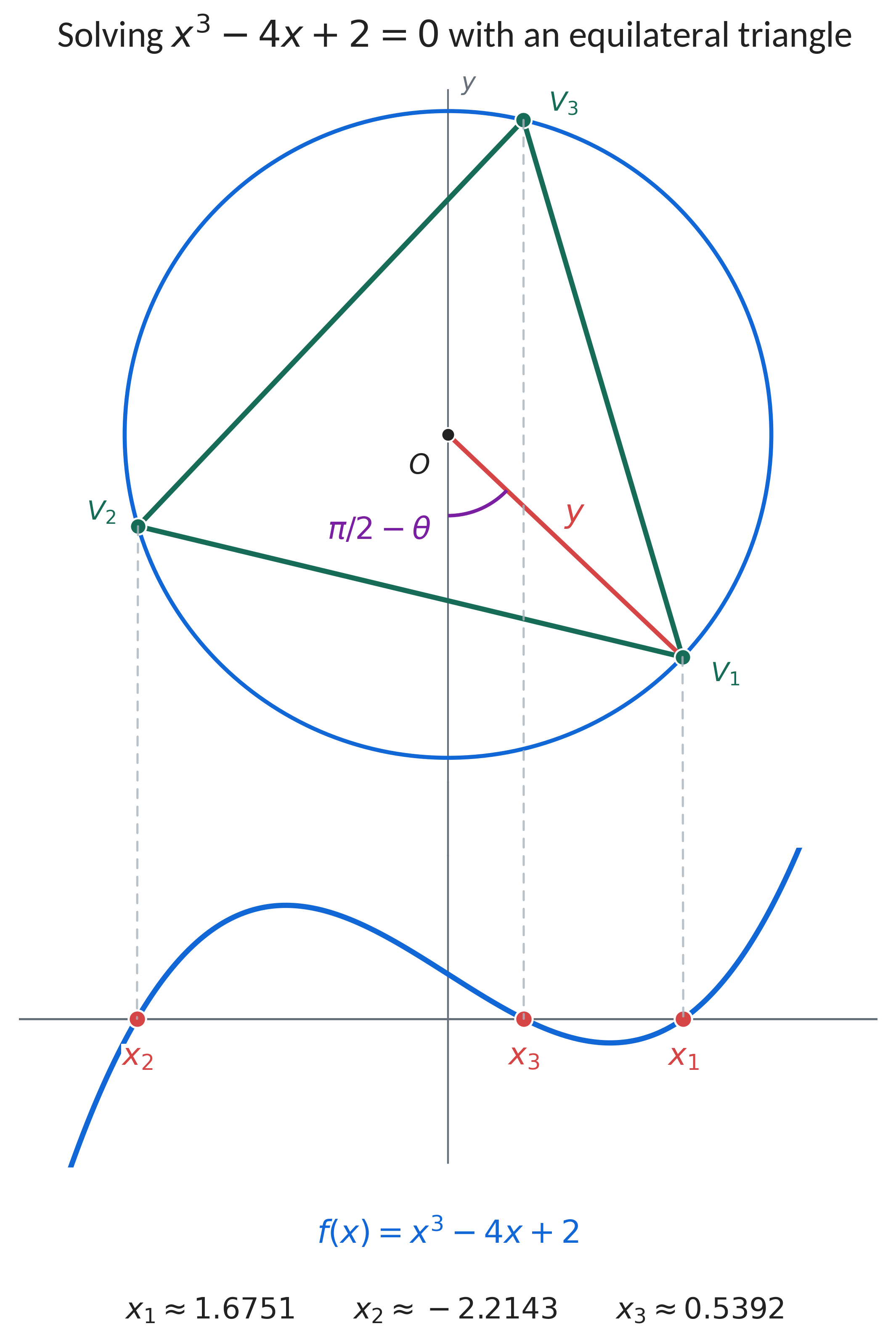
As an example, let’s solve the depressed cubic \(x^{3} - 4x + 2 = 0\) via the cosine formula. First, we must compute our scaling factor, which is \(2\sqrt{- \frac{- 4}{3}}\), or when simplifying, \(\frac{4\sqrt{3}}{3}\). Next, we need to find our rotation angle, \(\theta\). Plugging our values for\(p\)and\(q\)into our formula, we find
\[\theta = \frac{1}{3}\arccos\left( \frac{3(2)}{2( - 4)}\sqrt{- \frac{3}{( - 4)}} \right)\]
\[\theta = \frac{1}{3}\arccos\left( - \frac{3\sqrt{3}}{8} \right) \]While this is an exact expression for the rotation angle, an approximation for \(\theta\) is around \(\theta \approx 0.7592\ rad\). This is in between 1/12 and 1/8 of a full revolution, or \(\frac{\tau}{12} < \theta < \frac{\tau}{8}\).
Now, we can compute the x-values of each of the roots.
\[x_{1} = \frac{4\sqrt{3}}{3}\cos\left( \frac{1}{3}\arccos\left( - \frac{3\sqrt{3}}{8} \right) \right) \approx 1.6751\]
\[x_{2} = \frac{4\sqrt{3}}{3}\cos\left( \frac{1}{3}\arccos\left( - \frac{3\sqrt{3}}{8} \right) + \frac{\tau}{3} \right) \approx - 2.2143\]
\[x_{3} = \frac{4\sqrt{3}}{3}\cos\left( \frac{1}{3}\arccos\left( - \frac{3\sqrt{3}}{8} \right) + \frac{2\tau}{3} \right) \approx 0.5392\]
Here is a diagram illustrating the graph of this cubic, with the triangle, for reference:
Returning to a General Cubic
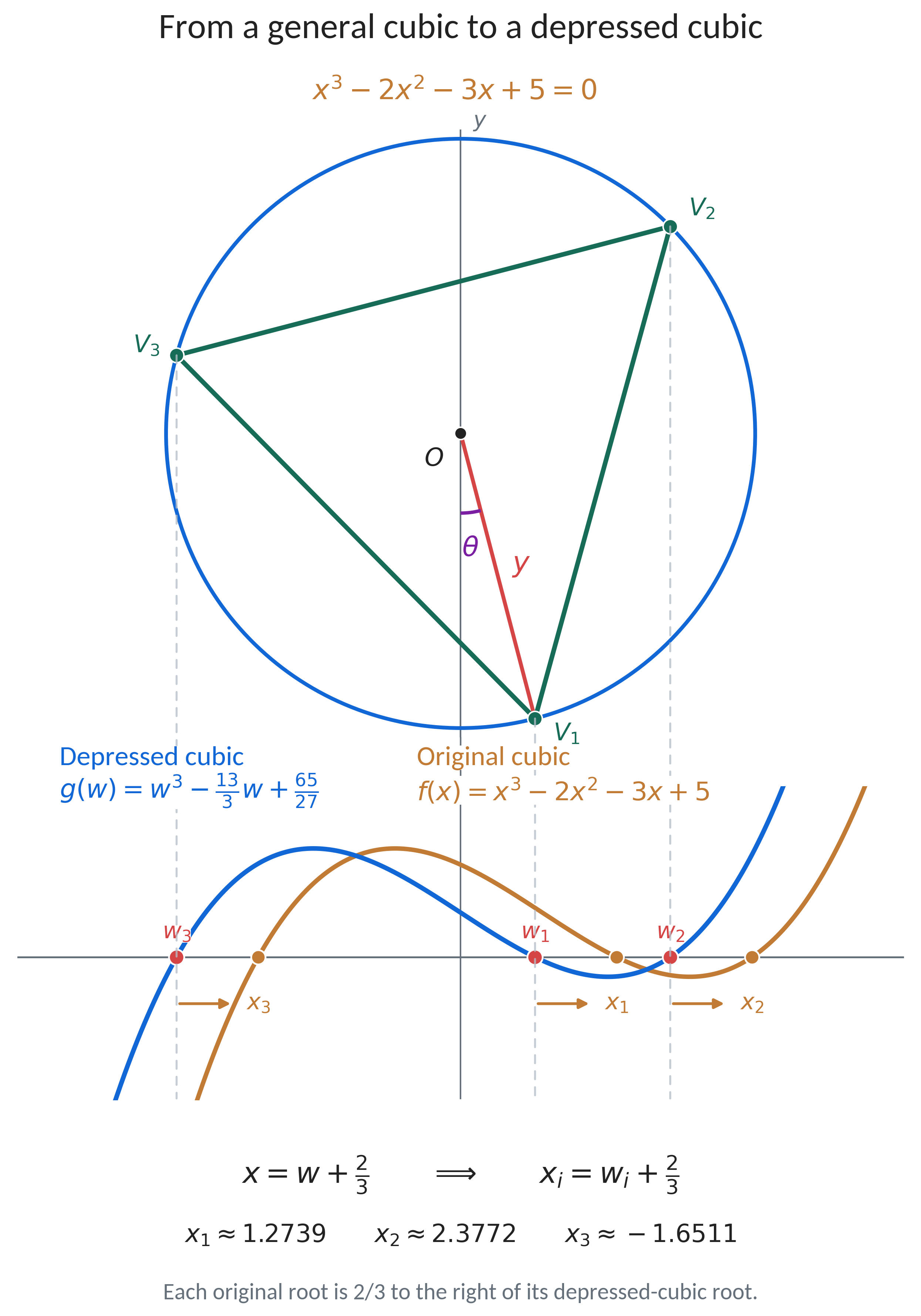
Here is an example where the cubic is not in depressed form: \(x^{3} - 2x^{2} - 3x + 5 = 0\). While it is possible to draw a triangle above the original cubic, without depressing it first, we would still need to find the critical points, which is much easier to do in depressed form.
Converting to depressed form:
\[\left( w + \frac{2}{3} \right)^{3} - 2\left( w + \frac{2}{3} \right)^{2} - 3\left( w + \frac{2}{3} \right) + 5 = 0\]
\[w^{3} - \frac{13}{3}w + \frac{65}{27} = 0\]
Now, we can find our scaling factor. Plugging in, we find
\[2\sqrt{- \frac{- \frac{13}{3}}{3}} = \frac{2\sqrt{13}}{3}\]
We can plug into the formula (sine version, although it doesn’t matter which) for \(\theta\).
\[\theta = \frac{1}{3}\arcsin\left( - \frac{3*\frac{65}{27}}{2* - \frac{13}{3}}*\frac{3}{\sqrt{13}} \right)\]
\[\theta = \frac{1}{3}\arcsin\left( \frac{5\sqrt{13}}{26} \right)\]
This rotation angle is very close to an angle of zero, being only around 0.2554 radians.
Now that we have both the scaling factor and \(\theta\), we can solve our depressed cubic.
\[w_{1,2,3} = \frac{2\sqrt{13}}{3}\sin\left( \frac{1}{3}\arcsin\left( \frac{5\sqrt{13}}{26} \right) + \frac{\tau k}{3} \right)\]
For the solution to our original cubic, we shift the roots back by adding \(\frac{2}{3}\) to the roots of the depressed cubic.
\[x_{1,2,3} = \frac{2\sqrt{13}}{3}\sin\left( \frac{1}{3}\arcsin\left( \frac{5\sqrt{13}}{26} \right) + \frac{\tau k}{3} \right) + \frac{2}{3}\]
Our final three solutions to the cubic \(x^{3} - 2x^{2} - 3x + 5 = 0\) are:
\[x_{1} = \frac{2\sqrt{13}}{3}\sin\left( \frac{1}{3}\arcsin\left( \frac{5\sqrt{13}}{26} \right) \right) + \frac{2}{3} \approx 1.2739\]
\[x_{2} = \frac{2\sqrt{13}}{3}\sin\left( \frac{1}{3}\arcsin\left( \frac{5\sqrt{13}}{26} \right) + \frac{\tau}{3} \right) + \frac{2}{3} \approx 2.3772\]
\[x_{3} = \frac{2\sqrt{13}}{3}\sin\left( \frac{1}{3}\arcsin\left( \frac{5\sqrt{13}}{26} \right) + \frac{2\tau}{3} \right) + \frac{2}{3} \approx - 1.6511\]
Here is a graph showing the original cubic, the depressed cubic, and the triangle:
The Algebra and Geometry Are the Same Thing
Why does the triple-angle identity fit an equilateral triangle so well? Move from one vertex to the next, and the angle changes by one third of a revolution, or \(\tau/3\). In the cosine form of the solution, multiplying that angle by three adds a complete turn:
\[\cos\left( 3(\theta + \tau/3) \right) = cos(3\theta + \tau) = cos(3\theta)\]
So the triple-angle expression stays the same even as we choose another vertex with a different horizontal coordinate. The threefold symmetry of the triangle is showing up directly in the algebra. This does not prove the triple-angle identity on its own, but it explains why that identity fits the three roots so naturally.
In this last example, shifting the roots back also shifts the triangle horizontally. The substitution and the triangle are describing the same thing. What looked like a scaling factor in the algebra is the distance from the center of the triangle to each vertex.
The angle determines its rotation, and the three angular choices pick out its three vertices. Their x-coordinates give us the roots. So the three-real-root problem from the beginning of the chapter has become a problem of scaling, rotating, and shifting a triangle!
Footnotes
J. J. O’Connor and E. F. Robertson, “Tartaglia versus Cardan,” MacTutor History of Mathematics Archive, University of St Andrews, https://mathshistory.st-andrews.ac.uk/HistTopics/Tartaglia_v_Cardan/.↩︎
Robin Hartshorne, “Viète’s Construction of the Regular Heptagon,” University of California, Berkeley, https://math.berkeley.edu/~robin/Viete/construction.html; J. J. O’Connor and E. F. Robertson, “François Viète,” MacTutor History of Mathematics Archive, University of St Andrews, https://mathshistory.st-andrews.ac.uk/Biographies/Viete/.↩︎
Emil M. Prodanov, “The Siebeck–Marden–Northshield Theorem and the Real Roots of the Symbolic Cubic Equation,” Results in Mathematics 77, article 126 (2022), https://doi.org/10.1007/s00025-022-01667-8.↩︎