Mathematics
One of my favorite things about mathematics is when two ideas that look completely different turn out to be connected. An equation can describe something one way, and a geometric picture can show us what is actually going on. Sometimes that makes the algebra much easier to understand.
The Beauty of Mathematics
I started writing The Beauty of Mathematics because I kept finding connections between subjects that seemed completely unrelated. Cubic equations lead to geometry, trigonometry leads to complex numbers, and eventually some of these ideas come together in Euler’s identity.
I wanted to understand not just how these things work, but why they work, and to explain them using pictures and geometric constructions whenever possible. Sometimes a diagram can make an equation that looks impossibly complicated suddenly make sense.
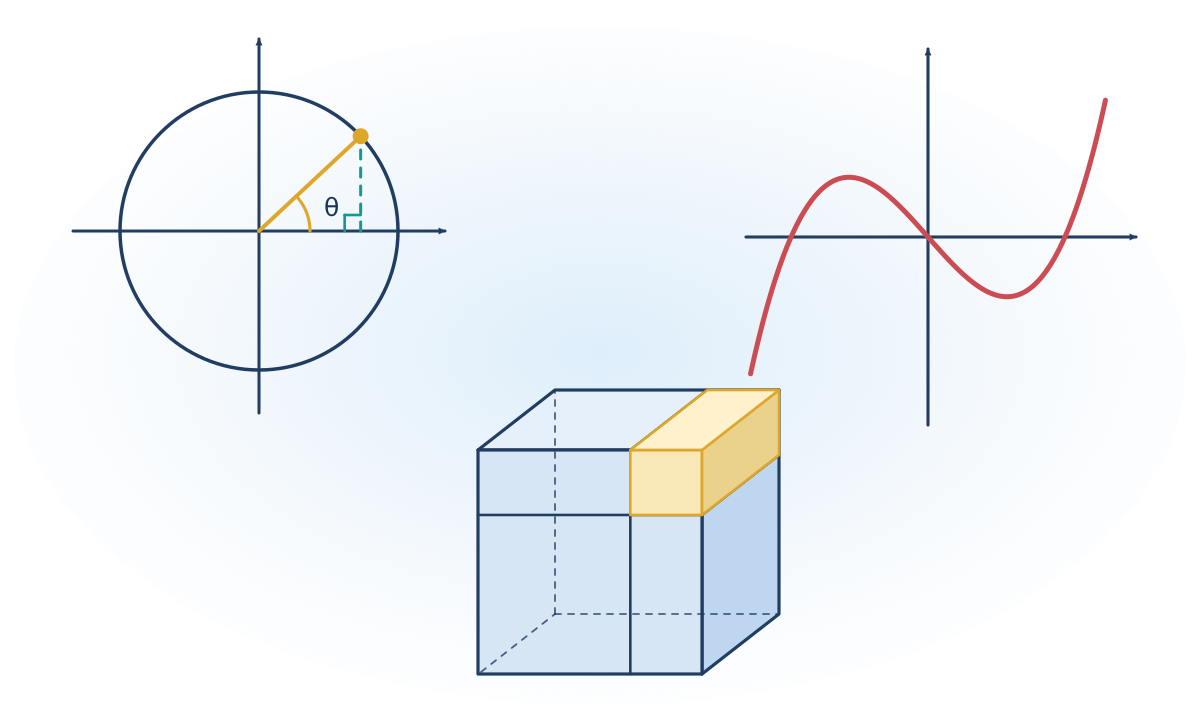
Research & Posters
Most of these projects started with a question I couldn’t quite leave alone. Could we extend completing the square into three dimensions? Could we see all three roots of a cubic just by rotating a triangle? And what happens when we take the same ideas into higher dimensions?
Completing the Square in 3D
CURC at Colorado State University · 2025
High School Honors
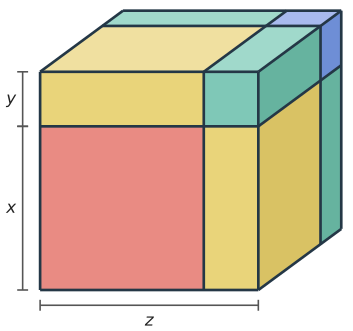
Completing the square gives us a geometric way to solve quadratic equations. But what if we try the same thing with a cube? I used the volumes of three-dimensional pieces to work through cubic equations, then explored how completing the cube twice gives a geometric construction for the general cubic. I also 3D-printed the pieces so the algebra could be assembled by hand.
Solving Cubic Equations Using a Triangle
Math Day at Colorado State University · 2025
First Place, Mathematical Ideas, History & Educational Innovations
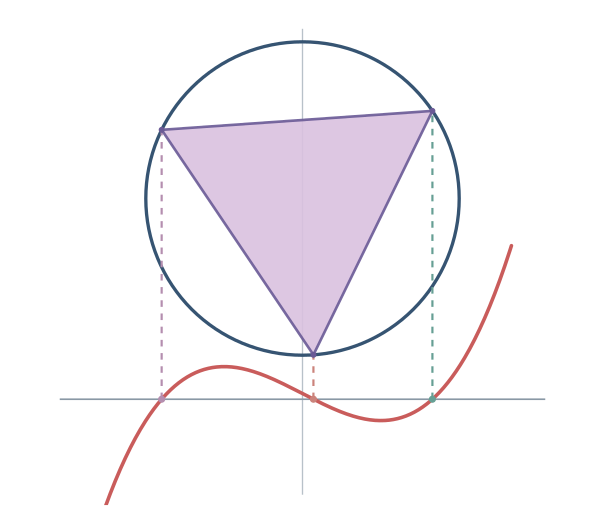
A cubic equation can have three real roots. Is there a way to see all three at once? I explored Viète’s trigonometric method using a rotating equilateral triangle. The horizontal positions of its three vertices can give the three solutions, connecting a cubic equation to the geometry of a circle.
The Geometry of Polynomials
CURC at Colorado State University · 2026
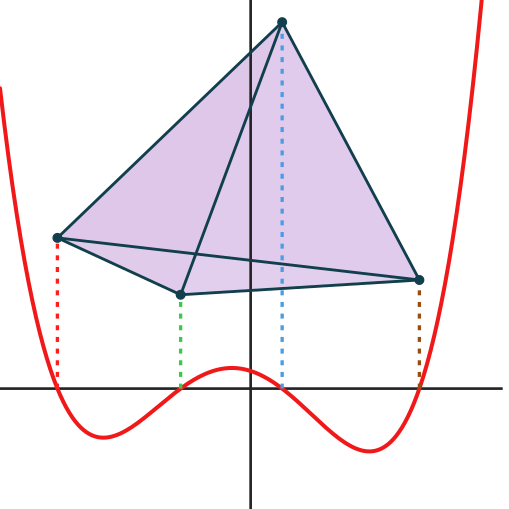
The triangle method and Cardano’s formula look very different, but they’re connected through complex numbers. I wanted to understand that connection, and whether a related idea could work for quartic equations. This project explores the cubic triangle alongside a geometric quartic construction using a regular tetrahedron.