The Geometry of Polynomials
When we solve polynomial equations, we usually work with symbols. But I keep finding that there is another way to look at the same algebra: we can draw it.
In my earlier projects, I used three-dimensional pieces to complete the cube and a rotating equilateral triangle to solve cubic equations. For this poster, I wanted to follow those connections further. Why does Cardano’s formula, which uses complex numbers, end up giving the same answers as a triangle? And if a triangle can represent three roots, what happens when we move into three dimensions and use a tetrahedron for four?
These aren’t new general formulas that I invented. The methods involve classical work on cubic and quartic equations, including Euler’s quartic solution and the tetrahedral interpretation studied by R. W. D. Nickalls. My project was to explore how the algebra and geometry fit together and make those relationships visible.
1. First, Simplify the Equations
The general cubic and quartic contain terms that make their geometry harder to see. Just as we did in the earlier posters, we can shift the horizontal coordinate to remove the second-highest power. This gives the depressed forms:
\[ \begin{aligned} \text{Cubic:}\quad &x^3+px+q=0,\\ \text{Quartic:}\quad &x^4+px^2+qx+s=0. \end{aligned} \]
We have not thrown away any solutions. We have simply moved the graph horizontally, and we can shift the answers back at the end.
The literal geometric constructions on this page focus on a cubic with three distinct real roots and a quartic with four real roots. The corresponding algebra is useful more broadly, but vertices in real space cannot have complex-valued horizontal coordinates.
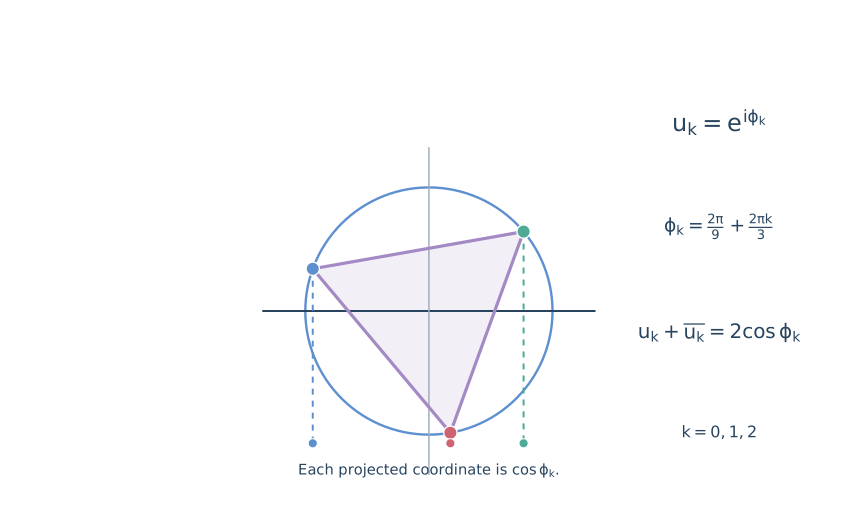
3. Moving from a Triangle to a Tetrahedron
A triangle has three vertices. A tetrahedron has four. Could those four vertices give the four roots of a quartic in a similar way?
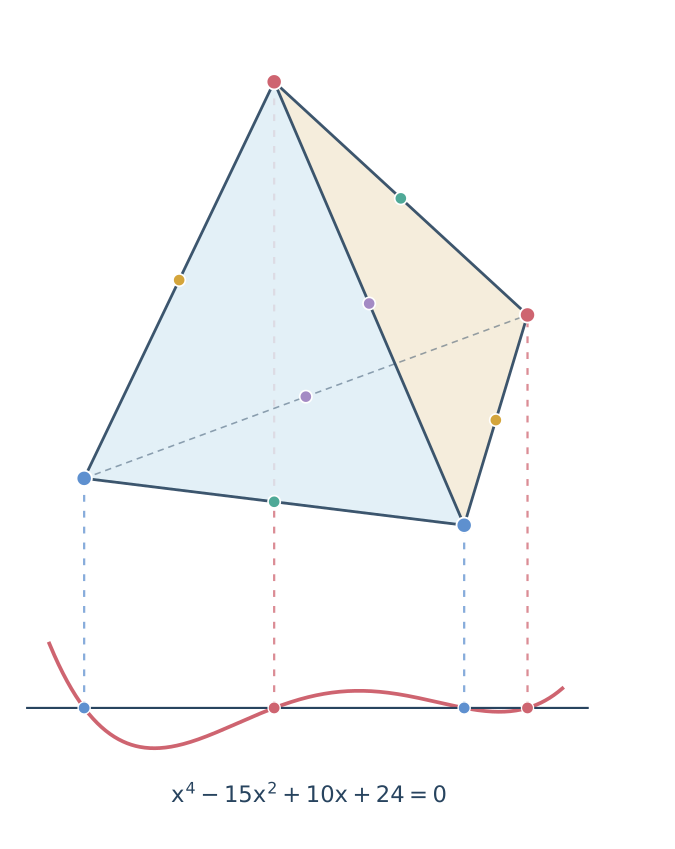
For a quartic with four real roots, the answer is yes. In the geometric interpretation, we can position and scale a regular tetrahedron so the horizontal coordinates of its vertices are the four roots of a depressed quartic.
But the part I find especially interesting is not just the vertices. It’s the midpoints of the edges.
A tetrahedron has six edges, which divide into three pairs of opposite edges. Because the depressed quartic has no cubic term, its four roots add up to zero. If the roots are \(a,b,c,d\), then
\[ a+b+c+d=0. \]
Consider the midpoints of the edges joining \(a\) and \(b\), and joining \(c\) and \(d\). Their horizontal coordinates are
\[ \frac{a+b}{2}\quad\text{and}\quad\frac{c+d}{2}=-\frac{a+b}{2}. \]
So opposite edge midpoints come in equal-and-opposite pairs. We can do the same thing with the other two pairs of opposite edges.
4. The Resolvent Cubic Reveals the Midpoints
This is where the algebra comes back. Start with the depressed quartic
\[ x^4+px^2+qx+s=0. \]
Euler’s method leads to an auxiliary cubic, called a resolvent cubic:
\[ \boxed{t^3+\frac p2t^2+\frac{p^2-4s}{16}t-\frac{q^2}{64}=0}. \]
Suppose its three solutions are \(t_1,t_2,t_3\). In the tetrahedron picture, these numbers are the squares of the horizontal coordinates of the three pairs of opposite edge midpoints. This is a rather surprising connection: a cubic equation is telling us where to find pieces of a tetrahedron, and those pieces lead to the quartic roots.
To see the reconstruction, pick a tetrahedron vertex whose horizontal coordinate is \(a\). The three edges that meet there have midpoint coordinates
\[ m_1=\frac{a+b}{2},\qquad m_2=\frac{a+c}{2},\qquad m_3=\frac{a+d}{2}. \]
Now add them:
\[ m_1+m_2+m_3=\frac{3a+b+c+d}{2}=a, \]
since \(a+b+c+d=0\). In other words, adding the three midpoint coordinates gets us right back to the vertex. That’s why the quartic roots take the form
\[ x=\pm\sqrt{t_1}\pm\sqrt{t_2}\pm\sqrt{t_3}. \]
Not all eight sign combinations work. The signs must be selected consistently with the original quartic; geometrically, we choose three midpoints belonging to edges that meet at a common vertex. This gives the four vertices and, therefore, the four roots.
A Quartic We Can Check
Try
\[ x^4-15x^2+10x+24=0. \]
It factors as \((x+4)(x+1)(x-2)(x-3)\), so its roots are \(-4,-1,2,3\). The corresponding resolvent cubic is
\[ \begin{aligned} &t^3-\frac{15}{2}t^2+\frac{129}{16}t-\frac{25}{16}=0,\\ &\left(t-\frac14\right)(t-1)\left(t-\frac{25}{4}\right)=0. \end{aligned} \]
So the three midpoint-coordinate magnitudes are \(\tfrac12\), \(1\), and \(\tfrac52\). With the correct choices of signs, their sums give exactly \(-4,-1,2,3\). The numbers in the figure above come from this quartic, not an arbitrary sketch.
5. Why I Put These Methods Together
One method seems to be about taking cube roots of complex numbers. Another is about rotating a triangle. A third uses a tetrahedron and the midpoints of its edges. At first they look like completely different kinds of mathematics.
What interested me was finding that they fit together through the same underlying algebra. The triangle’s angles are hiding inside Cardano’s cube roots. The tetrahedron’s edge midpoints are hiding inside a resolvent cubic. We can solve an equation with symbols, then turn around and actually see where those same quantities live in a shape.
Original Research Poster and Sources
View my original 2026 CURC poster (PDF) →
The poster credits Ignacio Rojas and Manaya Golatt for helping me formulate ideas for this project. It also draws on R. W. D. Nickalls’s mathematical work, including:
- R. W. D. Nickalls, The quartic equation: invariants and Euler’s solution revealed, The Mathematical Gazette 93 (2009), 66–75.
- R. W. D. Nickalls, The quartic equation: alignment with an equivalent tetrahedron, The Mathematical Gazette 96 (2012), 49–55.
The original poster also thanks my dad, Tom Sweder, for his support and encouragement.