Solving Cubic Equations Using a Triangle
A cubic equation can have three real roots. Usually, we try to find those roots by working with the equation itself. But is there a way to see all three of them at once?
That was the idea behind my 2025 Math Day poster. We can take an equilateral triangle, put it inside a circle, and rotate it until the horizontal positions of its three vertices match the three roots of a cubic equation. The surprising part is that this isn’t just a nice picture. The triangle gives us a way to calculate those roots.
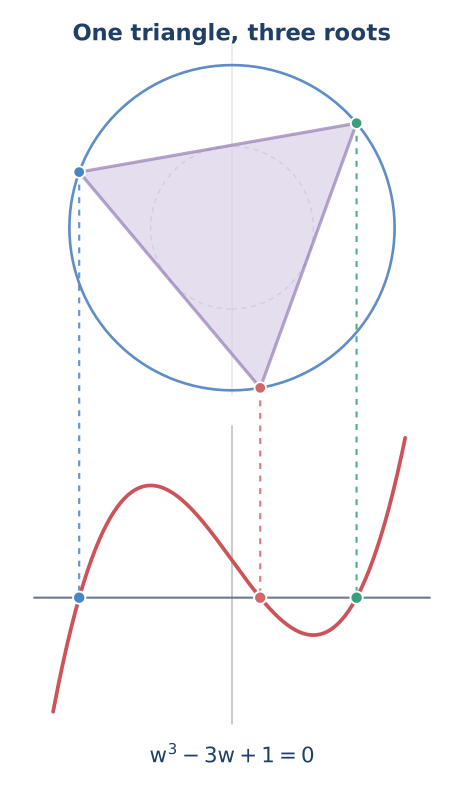
This is a geometric interpretation of Viète’s trigonometric method, not a new formula for the cubic. What interested me was how much of the algebra could be explained by a triangle and a circle.
1. Start with a Simpler Cubic
A general cubic has the form
\[ ax^3+bx^2+cx+d=0,\qquad a\ne0. \]
The \(x^2\) term gets in our way, but we can remove it by shifting the variable. If we substitute
\[ x=w-\frac{b}{3a}, \]
and collect terms, the equation becomes
\[ w^3+pw+q=0, \]
where
\[ \begin{aligned} p&=\frac ca-\frac{b^2}{3a^2},\\[2pt] q&=\frac{2b^3}{27a^3}-\frac{bc}{3a^2}+\frac da. \end{aligned} \]
This is called a depressed cubic. We will work with this equation first and shift the solutions back at the end. For this construction, we are interested in the case of three distinct real roots. That means \(p<0\), with \(q\) small enough that the cubic crosses the horizontal axis three times.
2. How Big Should the Triangle Be?
We need to decide how large the triangle should be before we can rotate it. And here is where the derivative of the cubic becomes useful.
The derivative is
\[ \frac{d}{dw}(w^3+pw+q)=3w^2+p. \]
Setting it equal to zero, we find the two turning points at
\[ w=\pm\sqrt{-\frac p3}. \]
Let’s place the triangle so that its center has the same horizontal position as the cubic’s inflection point, which is \(w=0\). Now draw its incircle, the smaller circle tangent to the triangle’s three sides. We can choose the triangle’s size so that the leftmost and rightmost points of that incircle are horizontally aligned with the cubic’s turning points.
For an equilateral triangle, the radius of its circumcircle is twice the radius of its incircle. So the circumradius must be
\[ \boxed{r=2\sqrt{-\frac p3}}. \]
We have now found the size of the triangle using only the coefficient \(p\). The coefficient \(q\) will determine how far to rotate it.
3. Rotating the Triangle to Find Three Roots
Start with one vertex pointing straight down. Rotate the triangle by an angle \(\theta\). Because the vertices of an equilateral triangle are separated by \(120^\circ\), their horizontal coordinates are
\[ \begin{aligned} w_0&=r\sin\theta,\\ w_1&=r\sin\left(\theta+\frac{2\pi}{3}\right),\\ w_2&=r\sin\left(\theta+\frac{4\pi}{3}\right). \end{aligned} \]
All three answers come from the same circle and the same angle. The only difference is that each vertex is one third of a full revolution from the next.
Try Braeden’s Interactive Triangle Construction
I also built an interactive version of this in Desmos. The graph has sliders that let you rotate the triangle and change its size. Try moving them one at a time. As the triangle turns or changes size, watch the horizontal positions of its three vertices. Those are the values we’re using to represent the cubic’s roots.
On a narrow screen, you may find it easier to use the full Desmos link. The static diagram above provides a reference even when the interactive graph cannot load.
4. Finding the Rotation Angle
So far, we know the radius of the circle, but not the angle. We need one more relationship.
If \(w_0,w_1,w_2\) are the roots of \(w^3+pw+q=0\), then factoring the equation gives us
\[ w_0w_1w_2=-q. \]
Using the three sine expressions for the roots, and the identity
\[ \sin\theta\sin\left(\theta+\frac{2\pi}{3}\right) \sin\left(\theta+\frac{4\pi}{3}\right) =-\frac14\sin(3\theta), \]
we can solve for the angle:
\[ \boxed{\sin(3\theta)=-\frac{3q}{2p}\sqrt{-\frac3p}}. \]
For a cubic with three distinct real roots, the expression on the right is strictly between \(-1\) and \(1\). One choice of angle is
\[ \theta=\frac13\arcsin\left(-\frac{3q}{2p}\sqrt{-\frac3p}\right). \]
Now substitute this angle into the three vertex-coordinate formulas. We have our three real roots without having to take the square root of a negative number.
For a general cubic, remember to reverse the original shift: \(x_k=w_k-b/(3a)\).
5. A Numerical Example
Let’s take
\[ w^3-3w+1=0. \]
Here \(p=-3\) and \(q=1\), so \(r=2\). The angle formula gives
\[ \sin(3\theta)=\frac12,\qquad \theta=10^\circ. \]
Our triangle’s horizontal vertex coordinates are
\[ \begin{aligned} w_0&=2\sin(10^\circ)\approx0.347,\\ w_1&=2\sin(130^\circ)\approx1.532,\\ w_2&=2\sin(250^\circ)\approx-1.879. \end{aligned} \]
These are exactly the three real roots of the cubic. The static figure near the beginning of this page shows the triangle and cubic corresponding to \(\theta=10^\circ\).
6. From Triangles to Tetrahedra
Once I had a triangle that could represent the three roots of a cubic, I started wondering about the next dimension. Could a tetrahedron, with its four vertices, do something similar for a quartic equation?
That was one of the directions I explored after this poster. The geometric idea extends into three dimensions, although the algebra and the conditions for the construction need their own explanation. I returned to this subject in my later work on the geometry of polynomials.
Original Poster
I presented Solving Cubic Equations Using a Triangle at Colorado State University’s 2025 Math Day, where it received First Place in Mathematical Ideas, History & Educational Innovations.